
How to Choose Your First Katana
Most beginner katana advice starts with steel.
“Get 1060.”
“No, get 1095.”
“Actually, T10 is better.”
That is not a terrible conversation to have, but it is a terrible place to begin.
When you are buying your first katana, the biggest problem usually is not choosing the wrong steel. It is buying a sword whose description sounds impressive but tells you almost nothing.
So here is my short answer:
The best katana for a beginner is usually a moderately priced, full-tang sword with clear specifications, sensible dimensions, secure fittings, and a construction story you can actually understand.
I would usually look in the $250–$500 range. I would rather buy a simple sword with honest information than an expensive sword covered in words like “battle ready,” “hand-forged,” and “premium quality.”
Those words may be true. They may also be doing a lot of work.
First, decide what kind of beginner you are
There is no single “beginner katana” because beginners do not all want the same thing.
Some people want a straightforward sword without much decoration. They care about the blade, the handle, the weight, and whether the product page gives them enough information to make a decision.
Some people are really buying the traditional appearance. They want a visible hamon, a bo-hi, a differentially hardened blade, and fittings that look like they belong on a Japanese sword.
Others want a dramatic centerpiece. For them, copper fittings, elaborate saya, unusual tsuba, and distinctive engraving may matter just as much as the blade.
None of these buyers is wrong.
The mistake is pretending that all three are shopping for the same product.
If I wanted a simple first katana, I would start with the IronPoet katana collection and immediately compare the actual specifications rather than scrolling by appearance alone.
If I wanted the traditional look, I would look more closely at the T10 and clay-tempered models.
If I wanted a decorative statement piece, I would judge the sword as a complete object rather than pretending that the steel specification was the only thing that mattered.
That first decision makes the rest much easier.
The product page is part of the product
A katana listing should answer basic questions before it starts talking about beauty.
What is the blade made from?
How long is it?
How much does it weigh?
How long is the handle?
Is the tang described?
What kind of tempering or heat treatment is claimed?
Are there clear photographs of the fittings and saya?
If the answer to all of those questions is “please admire the sword,” I would keep looking.
The product page itself is a kind of evidence. Specific numbers do not guarantee a perfect sword, but vague adjectives guarantee very little.
This is also why terms such as full tang, bo-hi, nakago, mekugi, and tsuka are worth understanding. The Katana Terms for Beginners guide is a good place to start if those words still feel like alphabet soup.
A full tang is useful information. It is not a complete quality report.
It tells you that the blade extends into the handle. It does not tell you whether the handle is fitted tightly, whether the fittings are secure, or whether the assembly was done carefully.
Think of it as one important part of the construction—not a magic stamp that makes every other detail irrelevant.
The steel-number competition is mostly noise
Steel numbers are useful. They are just not a ranking system.
1060, 1095, T10, and manganese steel all tell you something about the material. They do not tell you everything about the finished blade.
A steel label is more like a car model than a road test. It tells you what the manufacturer started with. It does not tell you how well this particular sword was heat-treated, finished, or assembled.
A 1095 blade that was treated badly does not become excellent simply because the number looks impressive.
A simpler steel with good geometry and consistent treatment may be a much more sensible purchase.
The Metropolitan Museum of Art’s overview of Japanese blade manufacture explains the basic tradeoff: steel needs enough carbon to harden, but excessive hardness can also make it more brittle.
That is why traditional Japanese blades were not designed around one simple idea such as “harder is always better.”
The blade needs an edge that can become hard, but it also needs a body that can tolerate stress. Construction and heat treatment are part of the answer.
A recent materials study of Japanese sword edge specimens makes the same point in more technical language. The behavior of a blade depends on its microstructure and treatment, not just a single hardness value.
So when I read a product listing, I ask a simple question:
Does the steel name come with any useful context?
If the answer is no, I treat the steel name as a starting point, not a conclusion.
T10 is not a personality
T10 is common in modern katana listings, especially on swords advertised with clay tempering and a visible hamon.
That can be a perfectly reasonable choice.
But T10 does not automatically tell me that the sword is better than every 1060 or manganese-steel blade. It tells me that the seller is pointing toward a particular type of carbon steel and, often, a particular visual style.
The same applies to manganese steel.
When a listing says “manganese steel,” I want to know what else is being disclosed. What are the dimensions? What is the weight? Is the tang described? Is the heat treatment explained? Are the photos detailed enough to inspect the fittings?
“Manganese steel” may be useful information, but it is not a complete specification.
This is why I am suspicious of listings that spend more time praising the steel than describing the sword.
The steel is inside the blade.
The information is supposed to be on the page.
The hamon question
A hamon comes from differential hardening. The edge and the rest of the blade receive different treatment. The Japan Cultural Expo’s explanation of hamon gives a concise introduction to the traditional process.
The hamon tells you something about how the blade was treated. It also gives the sword much of its traditional visual character.
Many buyers want one for exactly those reasons.
That is enough.
You do not need to turn the hamon into a universal quality score. A beautiful hamon does not describe the handle, the balance, or the fit of the fittings.
If the hamon is the part of the sword that excites you, choose a sword that explains how it was produced. The word itself gives you limited information.
The same idea applies to folded steel.
Folding helped traditional smiths refine tamahagane, which had uneven carbon distribution and impurities. Modern commercial steel begins with a more controlled material.
Today, folding can be valuable as craftsmanship and visual character. That is a good reason to want it.
Full Tang Is One Part of the Build
A full tang means the blade steel extends through the handle. It tells you something important about the sword’s construction.
The rest of the assembly deserves the same attention.
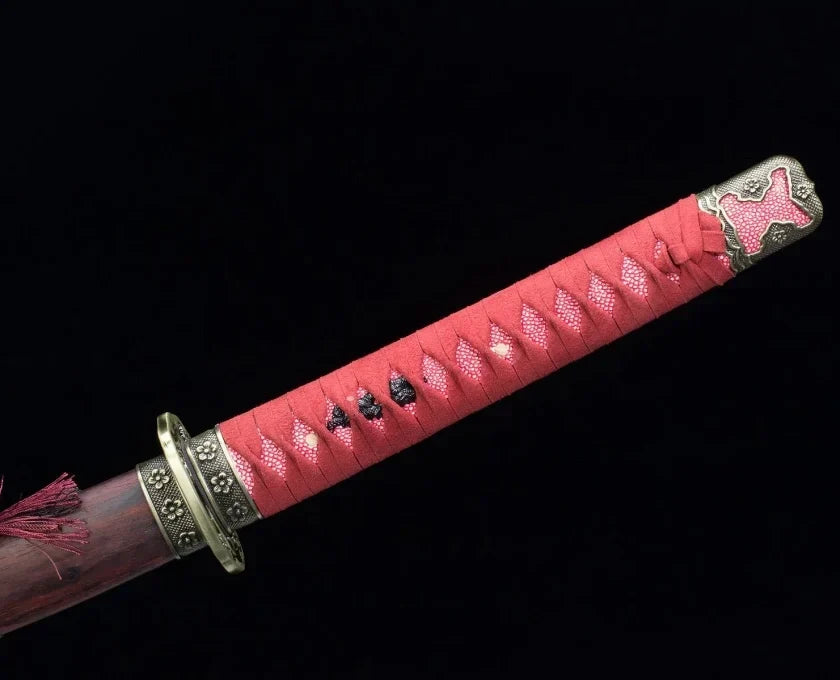
Look at the handle fit. Check the fittings. Examine the mekugi. Pay attention to the saya. These parts affect the finished sword and the way it holds together.
A katana is made from several fitted components: the blade, nakago, tsuka, mekugi, tsuba, and saya. Each part has a job.
The Katana Terms for Beginners guide explains the basic parts that appear in many product listings.
When I read a product page, I look for a clear picture of the complete sword:
- Does the handle look tightly fitted?
- Are the fittings described?
- Do the dimensions make sense together?
- Does the sword look like one coherent build?
That last question catches a lot. A well-made katana should look like one complete object, with every part working toward the same design.
Weight and geometry are easier to feel than steel
You can read about steel for an hour.
You will notice the sword’s dimensions much faster.
Blade length, thickness, curvature, handle length, weight, and balance shape the way a katana feels. Two swords with similar steel can still have completely different personalities.
A bo-hi removes material from the blade and changes its weight distribution. Some people prefer the lighter feel. Others prefer the more solid feel of a blade without one.
A longer tsuka changes the relationship between your hands and the sword.
A heavier fitting package changes the balance of the complete sword.
These details are not rankings. They are descriptions.
The Rosewood Katana lists a 70 cm blade, a 27 cm tsuka, and a listed weight of 1,350g.
The Magatama Bo-hi Katana takes a different design direction with a bo-hi, T10 steel, clay tempering, and a visible hamon.
The two swords appeal to different preferences. The specifications help you understand why.
They are coordinates.
They tell you where the sword sits in relation to other swords.
This is why simply stating "battle ready" on the product page is insufficient to explain everything. The phrase does not tell you the blade length, thickness, weight, balance, or assembly quality. For a clearer explanation of that label, see Battle Ready vs. Decorative Katana.
What are you actually paying for?
Price is not a perfect quality meter, but it does tell you something useful: how many compromises the seller has probably had to make.
At the low end, you may find a sword with a named steel, a full-tang description, and useful dimensions. That is a good start. But the product may still give you less information about heat treatment, finishing, and consistency.
The Plum Katana, for example, is listed at $149 with 7Cr17MOV stainless steel, a full tang, a 106.5 cm overall length, and a listed weight of 850g without the saya.
That makes it easy to understand what is being sold. But it is still a different proposition from a carbon-steel katana with a documented tempering process.
At around $250–$500, I think the balance becomes more interesting. You have more room for a better-finished package, clearer specifications, and a blade that is designed around something more specific than simply looking like a katana.
Above $500, the question changes.
You may be paying for more elaborate fittings, specialized finishing, additional handwork, or a design that is simply more beautiful. That can be worth it. But I would not assume that every extra dollar produces a proportional improvement in the blade itself.
Sometimes you are buying performance.
Sometimes you are buying craftsmanship.
Sometimes you are buying copper fittings because you like copper fittings.
My actual recommendation
If you are buying your first katana, do not begin by asking which steel sounds most expensive.
Ask what kind of sword you want to own.
Do you want a simple blade that gives you a clear reference point?
Do you care most about the hamon?
Do you want traditional-looking fittings?
Do you want a decorative centerpiece?
Choose the blade style you actually want.
Pay attention to steel, heat treatment, geometry, weight, and fittings as separate parts of the same object.
A hamon can be important to you. A bo-hi can be important to you. A particular tsuba or saya can be important to you.
Let those features reflect your preferences. Let the specifications explain the sword.
That is how a first katana becomes a good purchase.
My default recommendation would be a moderately priced katana with:
- a clearly identified blade material
- published dimensions and weight
- a full tang
- sensible geometry
- secure-looking fittings
- a product description that explains more than it advertises
Let those features reflect your preferences. Let the specifications explain the sword.
It is the sword that lets you understand what you bought.
The Katana Care and Maintenance guide is the next useful step once you have made your choice. A sword rewards regular attention for a long time.
Read more
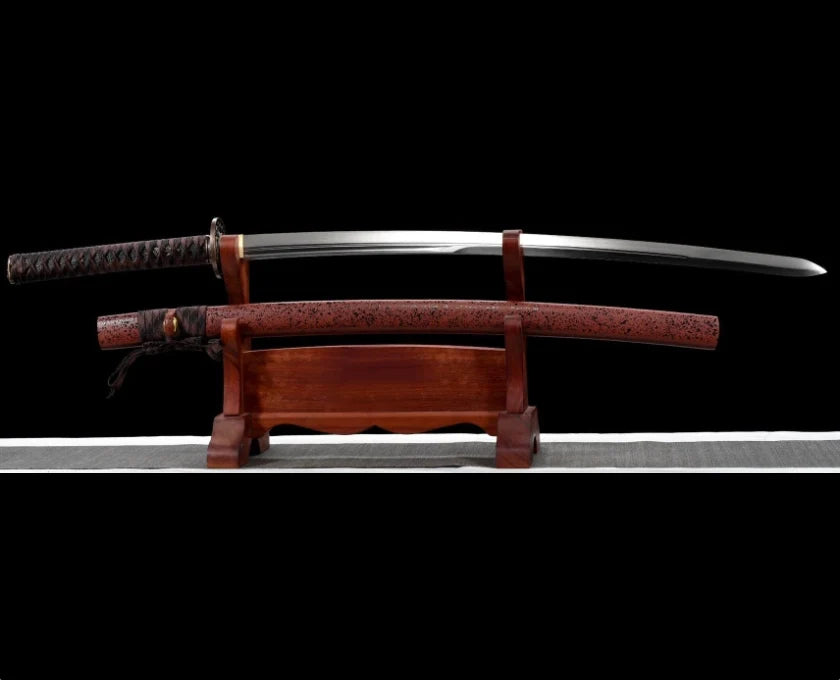
Daily and short-term storage for a modern katana The sword stand looks right. The room looks dry. You slide the katana into its saya and place it where you can see it. So far, so good—unless the bl...
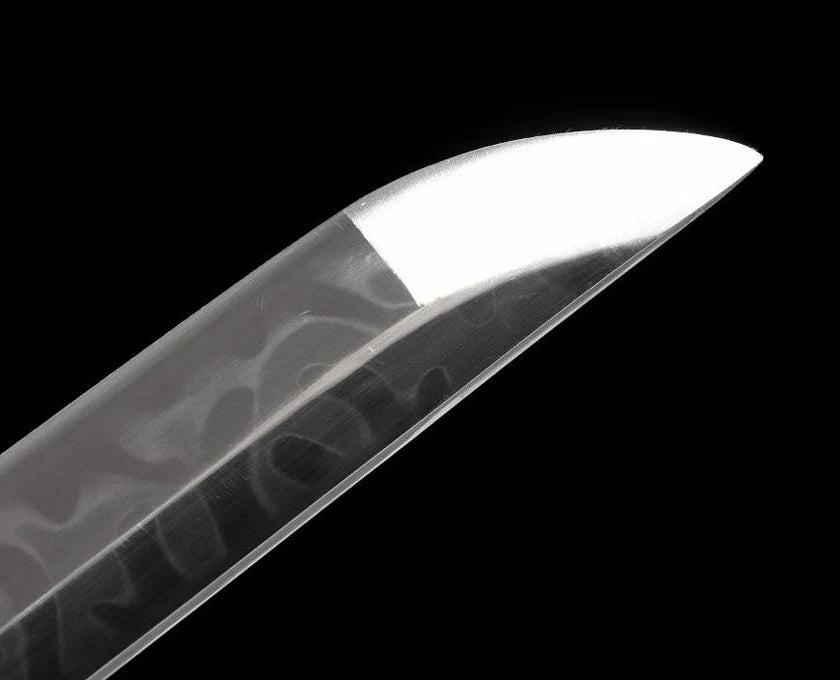
This guide explains the kissaki—the distinct tip section of a Japanese sword—and breaks down the yokote, fukura, boshi, ko-shinogi, and kaeri. It compares the main kissaki types, including ko-kis...
Leave a comment
All comments are moderated before being published.
This site is protected by hCaptcha and the hCaptcha Privacy Policy and Terms of Service apply.