
How to Read a Katana for The First Time
Japanese sword terms can feel overwhelming because the blade has names for areas that look almost identical at first. The easiest way to begin is to read a sword in four parts: its overall shape, its tip, its edge, and its tang.
This guide explains the main Japanese sword anatomy terms shown in a standard blade diagram. It also explains why those details matter, using a few short historical examples.
What are the main parts of a Japanese sword?
The main visible parts of a Japanese sword are the blade body, the cutting edge, the tip, and the tang inside the handle. Each section has its own Japanese name. These terms describe location, shape, dimensions, or evidence left by the forging and mounting process.
Start with the blade’s outline before looking at smaller details.
How do you describe a Japanese sword's overall shape?
A sword’s shape is described through its length, curvature, width, and thickness.
A. Nagasa / Hacho is the blade length. It does not include the tang. B. Zencho is the overall length, including the tang.
C. Sori is the curvature of the blade. A sword with deep sori has a more pronounced curve. A sword with shallow sori looks straighter.
The blade’s width is measured near both ends:
-
D. Motohaba is the width near the base.
-
E. Sakihaba is the width nearer the tip.
Its thickness is also measured at two points:
-
F. Motokasane is the thickness near the base.
-
G. Sakikasane is the thickness near the tip.
These dimensions show how a blade tapers. A sword may be long but narrow, broad but only lightly curved, or deeply curved with a small tip. Looking at these features together gives a much better impression of the blade than length alone.
A story in the curve
A late-Heian tachi attributed to Yasuie gives a useful example. Its blade is relatively narrow, 77.3 cm long, and has 3.2 cm of curvature. That combination produces the elegant, strongly curved profile many readers associate with early Japanese long swords.
A later tachi by Sukehisa has a small tip and a curve that is strongest closer to the base. Its shape is associated with early Old Bizen work. The two swords show why one measurement never tells the whole story. The curve, width, taper, and tip work together.
What is the kissaki on a Japanese sword?
H. Kissaki is the tip section of a Japanese sword. It begins at the I. Yokote, the line that separates the tip from the rest of the blade.
The kissaki has several smaller parts:
-
J. Fukura is the curve of the cutting edge within the tip.
-
K. Koshinogi is the ridge area above the yokote.
-
L. Mitsukado is the triangular area in the tip.
-
M. Shinogi-mitsukado is where the main ridge meets that triangular area.
-
N. Boshi is the hardened-edge pattern as it continues into the tip.
The kissaki is not simply the sharp end of the blade. It has its own geometry and its own continuation of the hardening pattern.
Why do different kissaki shapes matter?
Tip shape can help describe a sword, but it should not be treated as a quick dating tool. A small tip, a broad tip, or a long tip makes more sense when viewed together with the sword’s curvature, width, and tang.
The Sukehisa tachi mentioned above has a small tip, known as kokissaki. That feature matters because it appears with other features of its style. On its own, a small tip cannot identify a period or a maker.
When looking at a sword image, find the yokote first. Then compare the size of the kissaki with the rest of the blade. Look at the fukura and follow the boshi into the point.
What is the difference between ha, hasaki, and nioiguchi?
These terms are related, but they describe different things.
O. Mune is the back of the blade. P. Shinogi is the long ridge line that runs along the blade. Q. Shinogi-ji is the surface between the ridge and the blade back. R. Ji is the main surface below the ridge.
On the cutting side, S. Ha is the hardened edge area. T. Hasaki is the actual cutting edge at the outermost boundary.
U. Nioiguchi is the visible line that separates the hardened area from the rest of the blade. V. Ashi are extensions from the nioiguchi toward the cutting edge.
In short:
-
The ha is the hardened edge area.
-
The hasaki is the fine cutting edge.
-
The nioiguchi is the visible boundary of the hardening pattern.

A story in the edge pattern
The visible pattern along a Japanese sword’s edge is called the hamon. It forms during the quenching process. It is not added after the blade is finished.
A tachi made by Unji in 1335 carries an inscription naming the maker’s home province and the date. Its edge pattern is described as a medium-width straight line with small undulations. One sword can therefore show two kinds of evidence at once: information written into the tang and information created by heat treatment along the edge.
This is why details such as the nioiguchi and ashi matter. They are part of the blade’s physical structure, not surface decoration.
What is the nakago, and why can it be shorter than the blade’s original tang?
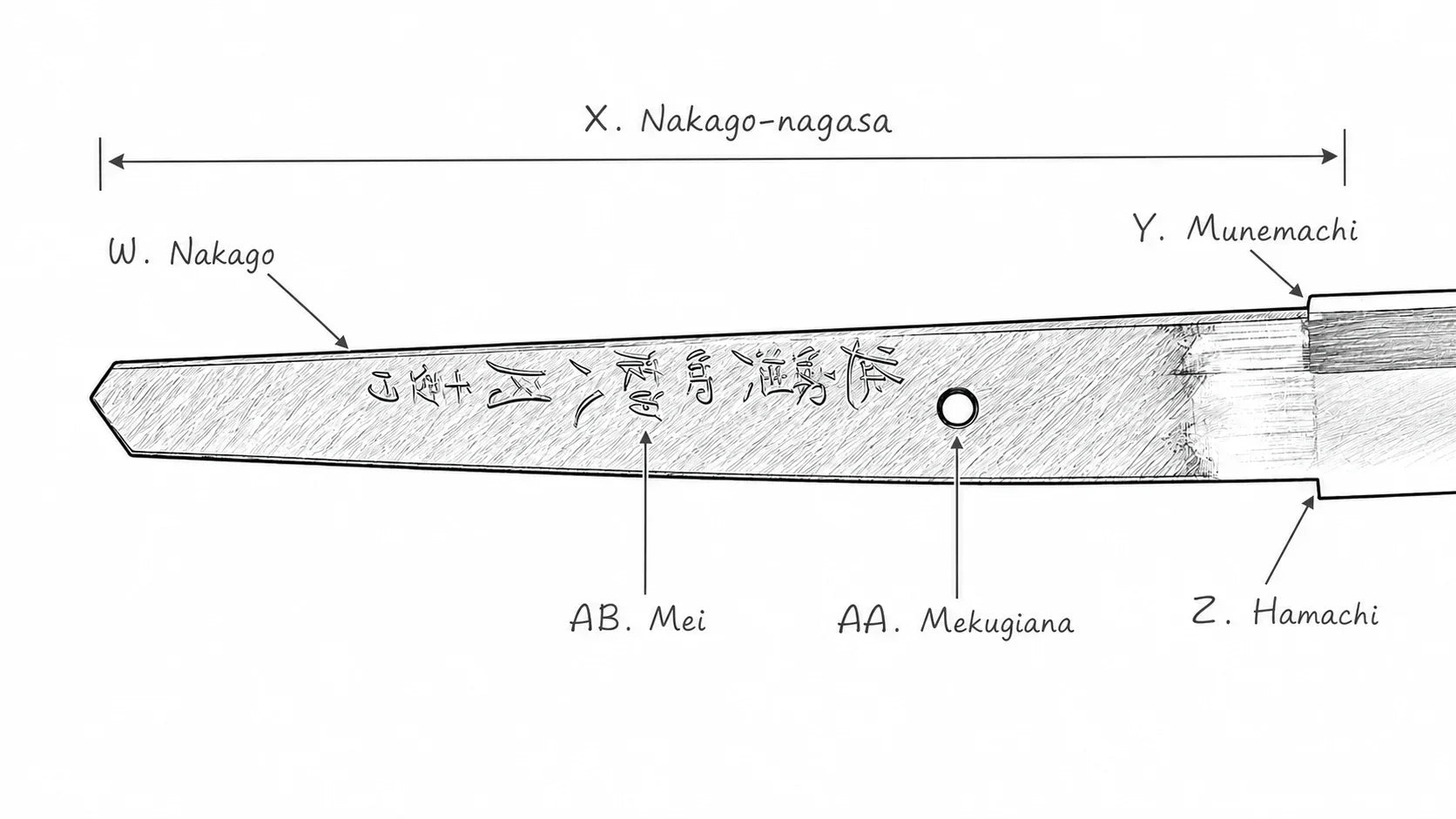
W. Nakago is the tang, the part of the blade that fits inside the handle. X. Nakago-nagasa is the tang length.
At the base of the blade are two notches:
-
Y. Munemachi is the notch on the blade-back side.
-
Z. Hamachi is the notch on the cutting-edge side.
AA. Mekugiana is the hole in the tang for the peg that secures the handle. AB. Mei is an inscription carved into the tang. A mei may contain a maker’s name, a date, a location, an owner’s name, or later appraisal information.
Why were some tangs shortened?
A process called suriage shortened the tang of an existing blade. Sword owners and craftsmen did this for practical or aesthetic reasons, often when an older blade was adapted to later mounting styles.
One documented example involves a blade by the Kamakura-period smith Rai Kunimitsu. It began as a long tachi. During the Edo period, Umetada Myoju shortened its tang and converted it into a katana.
That story explains why a sword’s current form may not be its original form. It also explains why a signature can be missing. If a craftsperson removed part of the tang, the original mei may have been cut away with it.
How can a tang preserve a sword's later history?
The tang can record more than the name of a swordsmith.
The blade known as Kuwana Go bears gold-inlaid inscriptions stating that it was shortened by Hon’ami Kotoku and later belonged to Honda Mino no Kami, a feudal lord associated with Kuwana. The inscription records alteration and ownership on the same blade.
For beginners, this is the useful lesson: a tang is not just a hidden mounting component. It may hold evidence about the sword’s maker, later owners, and changes made long after the blade was forged.
Frequently asked questions about Japanese sword anatomy
Is the kissaki the same as the entire point?
The kissaki is the complete tip section, beginning at the yokote. The very end is part of that section, but the kissaki also includes the fukura, boshi, and other shaped surfaces.
Does a larger kissaki always mean an older or more powerful sword?
No. Tip shape is one feature among many. Compare it with the blade’s sori, width, thickness, and tang before drawing any historical conclusion.
Does a mei prove who made a Japanese sword?
No. A mei is important evidence, but it is only one part of a specialist’s assessment. Some blades were unsigned, while others lost their original signatures when the tang was shortened.
Final note
Start with the large shapes. Find the curve, the tip, the ridge, the hardened edge, and the tang. The Japanese names become easier once you can see where each part belongs.
Read more
Few objects carry as much historical weight, technical sophistication, and cultural symbolism as the Japanese sword. Often called nihontō in Japanese, the traditional Japanese blade is far more tha...
If an early straight sword and a tachi from the Heian period were placed side by side, the first thing most people would notice would not be the inscription or the temper line, but the curve. One b...
Leave a comment
All comments are moderated before being published.
This site is protected by hCaptcha and the hCaptcha Privacy Policy and Terms of Service apply.