
How the Japanese Sword Became What It Is: Form, Warfare, Region, and Legend
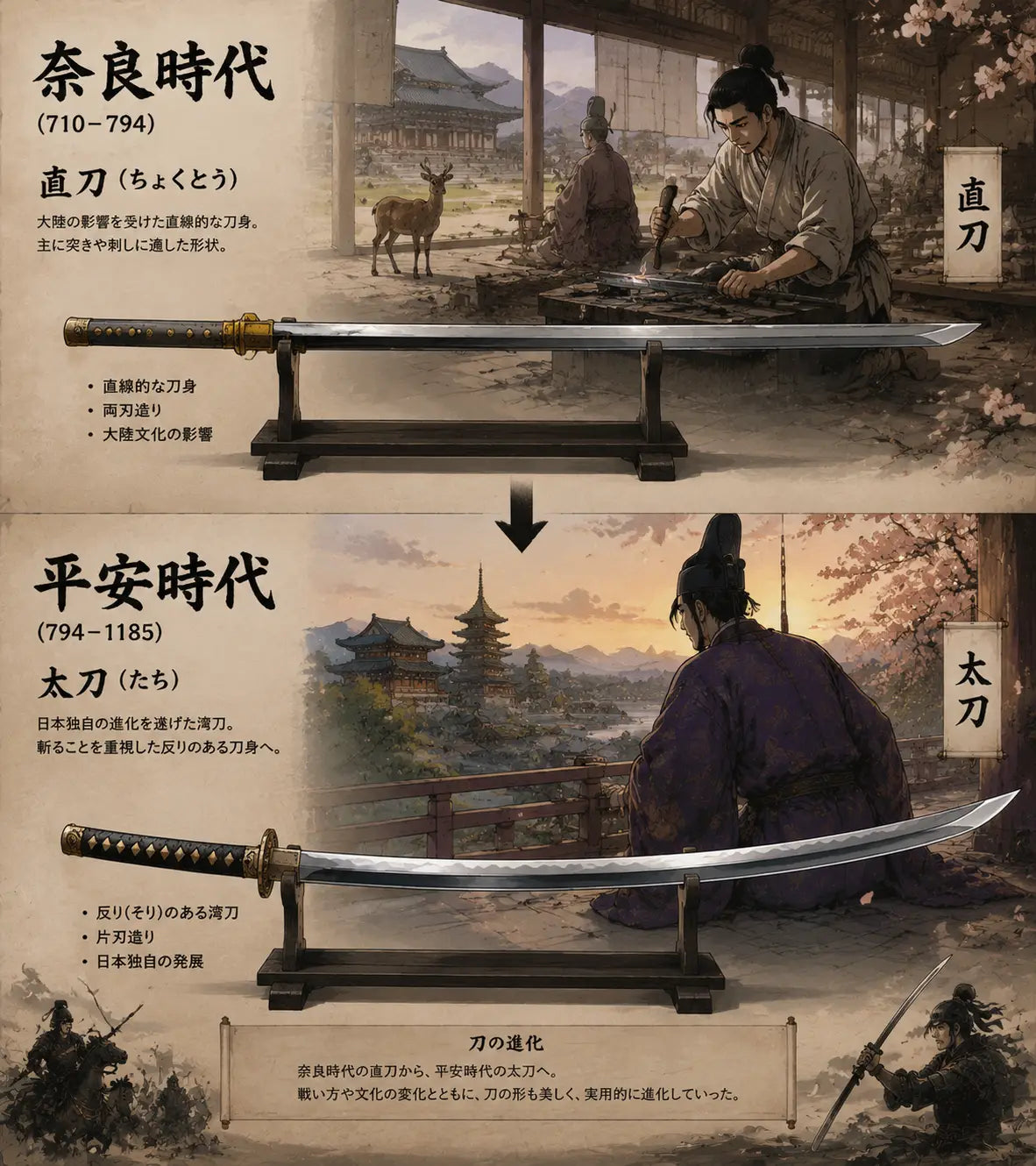
If an early straight sword and a tachi from the Heian period were placed side by side, the first thing most people would notice would not be the inscription or the temper line, but the curve.
One blade would resemble a straight line; the other would begin to curve gently from the tang. Both could be called swords, yet they represent different forms of warfare, methods of carrying, traditions of craftsmanship, and social systems.
The Japanese sword did not suddenly appear in its modern form at a single moment. It gradually became what we now understand as the Japanese sword through a long process of change.
That history can be understood through four questions:
Why did Japanese swords change from straight blades to curved blades?
Why did sword production become concentrated in certain regions?
How can we use a blade to judge its period and school?
Why do famous swords acquire stories that go beyond the physical object itself?
1. Why did Japanese swords change from straight blades to curved blades?
The age of straight swords: the early form of the Japanese sword
Before the Japanese sword emerged in its familiar form, the Japanese archipelago already had stone blades, bronze swords, and early steel swords. These weapons were closely connected to sword traditions on the Asian continent, and many metallurgical and forging techniques entered Japan through the Korean Peninsula and other routes.
Most of these early blades had little or no curvature and belonged to the category of straight swords. In terms of construction, they included hira-zukuri, kiriha-zukuri, and moroha-zukuri forms. The term “jōkotō,” or ancient sword, generally refers to these early swords from before curved blades became widespread.
A straight sword does not mean an underdeveloped sword. It suited the carrying methods and combat conditions of its time, and it often served ceremonial, ritual, and political functions as well.
For ancient rulers, a sword was never merely a tool for stabbing or cutting. It could also represent status, military authority, and sacred order. The closer a sword stood to the center of power, the more likely it was to possess both a martial and a ceremonial identity.
In practical terms, identifying an early sword requires more than looking at whether it is straight. Its construction, edge form, date, findspot, and transmission history must also be considered. “Straight sword” is a term for a form, not a synonym for “rough” or “unfinished.”

The image shows an early Japanese straight sword (chokutō) from the collection of The Metropolitan Museum of Art.
The conditions that produced curved swords
After the Heian period began, military power gradually shifted toward the samurai class. As the way wars were fought changed, swords also had to adapt.
The emergence of curved swords was connected with mounted combat, suspension-wearing methods, and cutting movements. A straight sword was effective for thrusting and direct blows, but when a warrior was moving on horseback or needed to deliver a continuous cut, a curved blade could produce a smoother cutting trajectory.
Imagine a mounted warrior swinging a sword from the side. If the blade is completely straight, the angle of the cut and the recovery movement are more restricted. If the blade has an appropriate curve, its edge can travel across the target rather than simply striking it.
This does not mean that a curved sword was automatically superior in every situation. More accurately, the shape of the sword became closely connected to the specific conditions of combat.
The Japanese Art Swords Preservation Society places the transition from straight swords to curved swords roughly after the middle of the Heian period. This change is often discussed in relation to the disturbances of Taira no Masakado and Fujiwara no Sumitomo, but it was not completed in a single year. It developed gradually over a considerable period. Japanese Sword Museum: History of Japanese Swords
The practical effects of curvature
The curve of a blade affects:
-
how a warrior carries the sword;
-
how the sword is drawn;
-
how it is swung from horseback;
-
how the blade absorbs impact;
-
how its weight is distributed.
By the late Heian period, the tachi had become a mature form of samurai sword. A tachi was generally worn suspended with the edge facing downward, and its blade had a pronounced curve. From the middle of the Muromachi period onward, the katana gradually replaced the tachi as the principal sidearm and was generally worn thrust through the sash with the edge facing upward. Japanese Sword Museum: Types and Construction
The “curvature” of the Japanese sword therefore involves three different layers:
First, it resulted from changes in warfare.
Second, it resulted from changes in the way swords were carried.
Third, it later became an important part of Japanese sword aesthetics.
Curvature as both technique and aesthetic
The curve did not originally appear for aesthetic reasons, but it eventually became one of the most recognizable visual features of the Japanese sword.
Heian-period tachi often curved strongly around the waist, while the area near the point was comparatively straight. During the Kamakura period, as the samurai class and the demands of warfare developed, blades became more substantial and powerful, and their curves and points changed accordingly.
When examining a Japanese sword, it is useful to begin with three questions:
Where is the curve strongest?
Is the point small and restrained, or broad and prominent?
How much does the width change between the base and the point?
These questions are often more meaningful than simply asking whether a sword “looks like a samurai sword.”
2. Why did Japanese sword production become concentrated in certain regions?
Swordsmiths did not gather randomly
A sword required more than the individual swordsmith. It also required stable resources, orders, and an environment in which skills could be transmitted.
Important conditions included:
-
access to iron and steel;
-
charcoal and water;
-
transportation;
-
demand from warrior houses, temples, shrines, and the court;
-
protection from local rulers;
-
master-disciple relationships and communities of swordsmiths.
A place with iron but no orders or transport networks would have difficulty developing a lasting tradition. Conversely, a political center lacking local mineral resources could attract swordsmiths through its power and connections.
The regional character of Japanese sword traditions therefore reflects not only where a swordsmith was born, but also the development of an entire production system.
Gokaden: a regional framework organized by later generations
In discussions of old Japanese swords, people often use the term Gokaden, or the Five Traditions:
-
Yamato;
-
Yamashiro;
-
Bizen;
-
Sōshū;
-
Mino.
These traditions are broadly associated with present-day Nara, Kyoto, the Okayama region, Kamakura and Sagami, and the Gifu region.

However, Gokaden does not refer to five schools with permanently fixed boundaries. It is a framework later developed by appraisers and scholars on the basis of regional origins, blade shape, jigane, and hamon. The Japanese Art Swords Preservation Society also explains that the Five Traditions are distinguished through regional tendencies in the texture of the forged steel, hamon, nie, and nioi. Japanese Sword Museum: Japanese Swords of the Five Traditions and Five Provinces
In my view, the best way to understand Gokaden is not to treat it as five rigid style labels, but as five long-standing technical and social networks.
Bizen: a tradition built through long-term production
Bizen was located in the area of present-day Okayama. Fukuoka, Yoshii, and Osafune became important centers of sword production for long periods.
The continuity of the Bizen tradition was connected with local materials, rivers, transportation, and demand. More importantly, once swordsmiths gathered in large numbers, master-disciple relationships and family lineages could preserve existing techniques while generating new branches.
Bizen swords were never a completely uniform style. Ko-Bizen, Fukuoka Ichimonji, and Osafune all belong to important parts of Bizen sword history.
Sōshū: innovation driven by the shogunate
The center of Sōshū was Kamakura. After the Kamakura shogunate was established, the warrior government’s demand for high-quality practical swords increased significantly. Swordsmiths from different regions were brought to Sagami, encouraging the development of the Sōshū tradition.
Sōshū is often associated with Masamune, who worked in the late Kamakura period. The tradition emphasized strength, activity in the jigane, and variation in the hamon, and it influenced swordsmiths in many other regions.
If Bizen represents a long-term production network, Sōshū more clearly reflects the influence of a political center and the demands of the warrior government.
Schools were not closed categories
Swordsmiths moved. Techniques traveled. Later schools absorbed traditions from other regions.
Therefore, when we hear the terms “Yamato tradition” or “Bizen tradition,” we should not immediately imagine a completely fixed specification. A more useful approach is to ask:
What period does this sword belong to?
Which branch of which regional tradition does it represent?
What features of the blade support that judgment?
Region can help narrow the possibilities, but it cannot replace close observation of the individual blade.
3. How can we use a blade to judge its period and school?
Identifying a Japanese sword does not depend simply on whether it is sharp, nor on the fittings around the blade. The most important evidence is the combined information preserved in the blade itself.
First, look at the overall form
Begin with the sugata, or overall shape:
-
length;
-
curvature;
-
the location of the strongest curve;
-
the difference between the motohaba and sakihaba;
-
the size of the point;
-
the thickness of the blade;
-
the overall form of a tachi, katana, or tantō.
Blade shape often reflects the needs of its period. A late-Heian tachi, a powerful middle-Kamakura tachi, and a Muromachi katana suited to foot combat will each have a different overall appearance.
In practical terms, it is better not to begin with the hamon. First understand the outline of the blade. Many differences between periods can be seen in the overall “presence” of the sword.
Second, look at the jihada
The jihada is the metallic pattern visible in the blade as a result of forging. It is not a surface decoration in the ordinary sense, but a visual expression of the steel and the forging process.
Yamato swords often show a noticeable masame tendency. Yamashiro swords are often valued for fine, closely forged grain. Bizen swords are frequently admired for utsuri and other changes in the jigane, while Sōshū swords often display abundant nie and chikei.
These are general tendencies, not absolute rules. Japanese sword appreciation requires the jihada to be considered together with the sugata, hamon, and inscription.


Jihada of a Japanese sword from The Metropolitan Museum of Art collection. This blade was made by the Gassan school and features the distinctive ayasugi-hada, characterized by unique concentric wood-grain patterns.
Third, look at the hamon
The hamon is the pattern formed along the edge through the hardening process. Common forms include suguha, chōji, gunome, notare, and midare.
The hamon is not merely decoration. It also records the swordsmith’s techniques and stylistic habits. The Japanese Art Swords Preservation Society explains that the hamon is related to the application of clay and the hardening process; details such as kinsuji, inazuma, ashi, yō, and sunagashi may also appear within the blade’s activity. Japanese Sword Museum: The Appeal of Japanese Swords
A common beginner’s mistake is to see one type of hamon and immediately assign a school. A more reliable method is:
First, record what kind of hamon it is.
Then observe how it is distributed across the entire blade.
Finally, compare it with the sugata, jihada, and nakago.
Fourth, look at the nakago, inscription, and signs of alteration
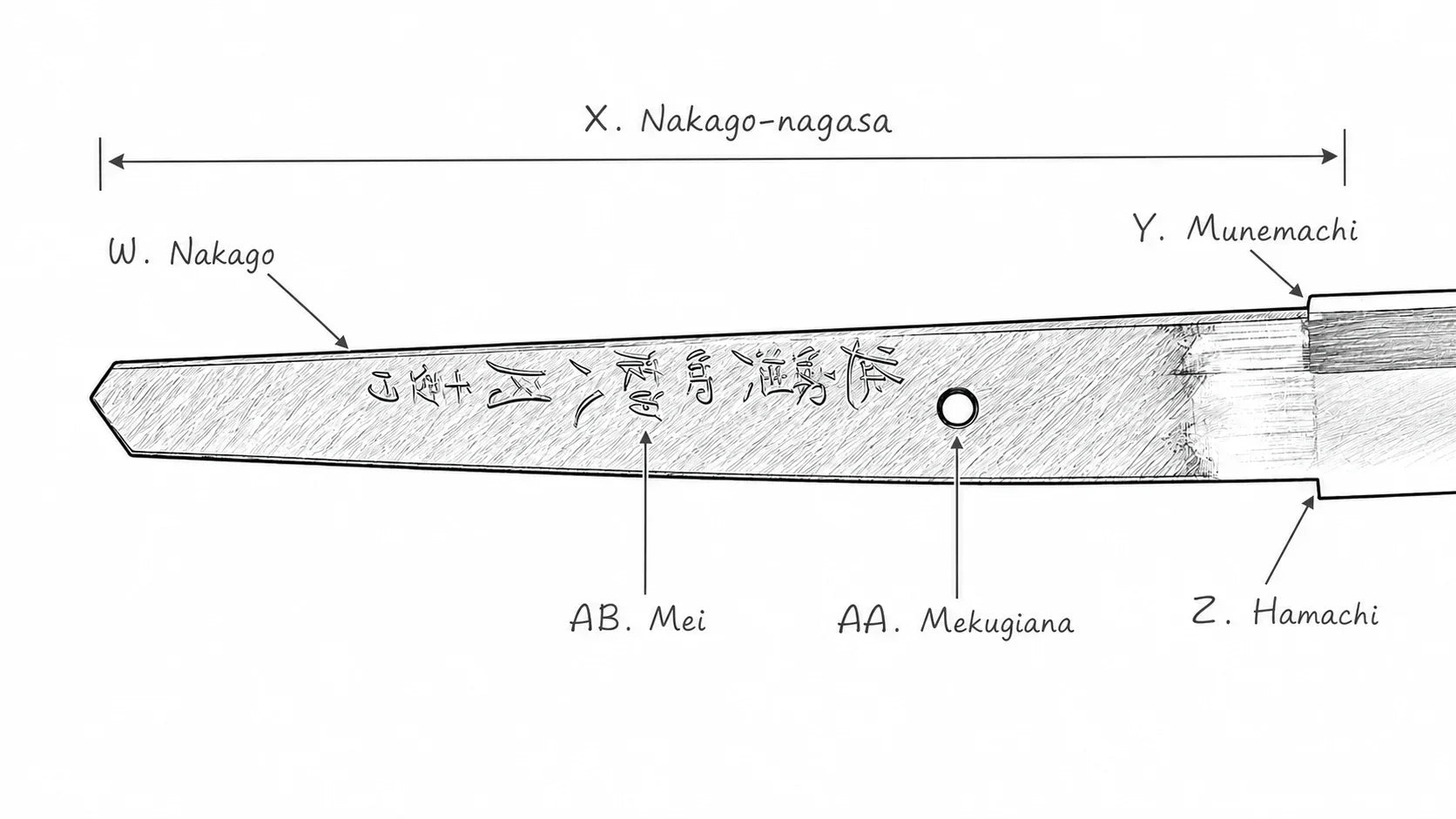
The nakago is the part of the blade hidden inside the handle. It is usually undecorated, yet it preserves a great deal of historical information.
Important points include:
-
the position of the inscription;
-
the number and location of mekugi-ana;
-
the length of the nakago;
-
its shape;
-
signs of suriage;
-
whether the blade was originally longer.
Many old swords were shortened in later periods to suit new methods of carrying them. After shortening, the original inscription, peg holes, and nakago form may no longer align in the same way. These changes can help researchers reconstruct the sword’s later history.
For this reason, appreciating a Japanese sword does not mean looking only at the most beautiful part of the blade. The nakago is often like a discreet résumé, recording what the sword has experienced.
Five representative blades: how the Five Traditions appear in individual swords
1. Yamato Tradition: a tachi attributed to the Taima school
The Taima school was connected with the Yamato tradition and the Nara region. The value of a tachi attributed to the Taima school does not necessarily lie in the fame of its legend, but in the way it helps us understand how Yamato swords are examined.
Researchers consider its form, point, jihada, and hamon, and then relate those features to the regional and temple background of the Taima school. The Tokyo National Museum’s material connects swords attributed to the Taima school with the Yamato tradition through features such as their broad, substantial bodies, point shapes, jihada, and hamon. e-Museum: Sword Attributed to the Taima School
The overall impression of the Yamato tradition is often restrained, practical, and solid. It is less a conspicuous decorative label than a disciplined technical tradition.
2. Yamashiro Tradition: Mikazuki Munechika
Mikazuki Munechika was made by Sanjō Munechika and is one of the representative swords of the Yamashiro tradition during the Heian period. Its blade measures approximately 80 centimeters, with a sori of about 2.7 centimeters, and it is now held by the Tokyo National Museum.
One of its most distinctive features is the strong curve from the tang through the lower half of the blade, while the upper half is comparatively straight. This preserves the classical form of an early Japanese tachi. A crescent-shaped pattern in the hamon gave the sword its name, “Mikazuki Munechika,” or “Crescent-Moon Munechika.” e-Museum: Mikazuki Munechika
Mikazuki Munechika later became part of the meibutsu system known as the “Five Great Swords Under Heaven” and passed through the Toyotomi and Tokugawa families. It therefore possesses three identities at once:
-
a Heian-period object;
-
a representative of the Yamashiro swordsmith tradition;
-
a famous blade whose reputation was strengthened by later collecting and political memory.
3. Bizen Tradition: Ōkanehira
Ōkanehira was made by the Bizen swordsmith Kanehira and belongs to the Ko-Bizen tradition. Its blade measures approximately 89.2 centimeters, with a sori of about 3.5 centimeters, and was made in the twelfth century during the Heian period.
Its unusual feature is its enormous size. Kanehira generally produced relatively slender blades with intricate tempering patterns, but Ōkanehira is much larger than his usual works. This is reflected in the name Ōkanehira, or “Great Kanehira.” The blade also retains the five-character signature “Made by Kanehira of Bizen.” e-Museum: Ōkanehira
Ōkanehira shows why school identification cannot rely only on regional impressions. Even within Bizen, differences in period, smith, and purpose could produce significant variations in length, curvature, and hamon.
4. Sōshū Tradition: Kanze Masamune
Kanze Masamune is an unsigned sword by Masamune, made in the fourteenth century during the Kamakura period. Its blade measures approximately 64.4 centimeters.
The tang was shortened at a later date, but an original Sanskrit character carved on it remains intact. The blade’s jihada and fine nie are especially important features when examining the Sōshū style associated with Masamune. e-Museum: Kanze Masamune
The sword is called Kanze Masamune because it was once owned by the Kanze family, a prominent Noh theater family. Later records state that Tokugawa Ieyasu took the sword from the Kanze family and gave it to Tokugawa Hidetada.
This illustrates a practical principle of sword appreciation: an unsigned blade does not lack an identity, but identifying it depends more heavily on its style, transmission history, and professional appraisal.
5. Mino Tradition: Kasen Kanesada
Kasen Kanesada was made by the second-generation Kanesada, also known as Nosada, a swordsmith of the Mino Seki tradition during the Muromachi period.
Its name is connected with Hosokawa Tadaoki. According to the later story, Tadaoki executed thirty-six retainers and associated the sword with the Thirty-Six Immortal Poets, or Sanjūrokkasen, giving it the name Kasen Kanesada. Relevant materials identify the sword as a work of the second Kanesada of Seki in Mino during the Muromachi period. Eisei Bunko: Materials on Kasen Kanesada
Kasen Kanesada reminds us that the representative character of the Mino tradition comes not only from hamon and blade shape, but also from its relationship to Sengoku society, warrior authority, and regional swordsmith traditions.
How five blades help us understand the Five Traditions
| Tradition | Representative blade | What to look for |
|---|---|---|
| Yamato | Tachi attributed to the Taima school | Restrained blade form, jihada, temple connections, and old swordsmith traditions |
| Yamashiro | Mikazuki Munechika | Heian tachi form, waist curvature, and crescent-shaped hamon |
| Bizen | Ōkanehira | Ko-Bizen, long blade form, signature, and exceptional scale |
| Sōshū | Kanze Masamune | Jihada, nie, hamon activity, and the Masamune style |
| Mino | Kasen Kanesada | Seki tradition, Muromachi practical swords, and meibutsu legend |
These five blades cannot represent every sword in their respective traditions, but they provide five entry points for understanding how regional traditions appear in individual objects.
For readers who want to develop a basic habit of observation, the following order is useful:
Look at the overall form first. Then examine the hamon and jihada. Finally, study the nakago, inscription, and transmission history.
4. Why do famous swords acquire stories that go beyond the physical object itself?
A famous sword consists of three layers
The cultural identity of a famous sword usually consists of three elements.
The first is the sword itself: its form, hamon, jihada, and inscription.
The second is its transmission history: its owners, family inheritance, wartime experiences, and collecting history.
The third is its later narrative: famous-sword catalogues, literary works, religious stories, and popular legends.
The same sword can therefore be studied as a metal object and remembered as a carrier of historical figures and stories.
Dōjigiri Yasutsuna: the sword and the hero’s legend
Yasutsuna was a swordsmith of the Heian period, and Dōjigiri Yasutsuna is one of Japan’s most famous meibutsu swords.
Later famous-sword records state that Minamoto no Yorimitsu used the sword to slay Shuten Dōji at Mount Ōe, which gave the sword the name Dōjigiri, or “Demon-Slayer.” The Tokyo National Museum also notes that the Shuten Dōji story itself seems to have taken shape during the Muromachi period, meaning that the physical sword and the legend were not created at the same time. e-Museum: Dōjigiri Yasutsuna
This distinction is important: Dōjigiri Yasutsuna is a Heian-period object, while the story of Yorimitsu slaying a demon is a later narrative that was repeatedly transmitted and reshaped.
In practical terms, when reading a famous-sword story, it is useful to ask three questions:
Where does the story first appear?
How long after the sword’s creation was it recorded?
Does the story concern the sword itself, or a later owner?
This approach preserves the appeal of the legend without treating it as direct proof.
Mikazuki Munechika: how a sword becomes a memory of power
The reputation of Mikazuki Munechika comes not only from its crescent-shaped hamon, but also from its transmission history.
The sword was once held by Kōdai-in, the wife of Toyotomi Hideyoshi, and later passed to Tokugawa Hidetada. Family inheritance, famous-sword catalogues, and the title “One of the Five Great Swords Under Heaven” gradually transformed Mikazuki Munechika from a Heian tachi into a cultural object carrying courtly, warrior, and national memories.
This shows that a famous sword’s value does not depend solely on its swordsmith. Its owners, transmission route, and later reputation can also change its cultural identity.
Masamune and Muramasa: historical swordsmiths and the cursed-sword legend
Masamune and Muramasa were both real historical swordsmiths, but they were not the simple master and rival often portrayed in popular stories.
Masamune worked in Sōshū during the late Kamakura period and became one of the most influential smiths of the Sōshū tradition. Muramasa belonged to the later Muromachi period. The later story of a contest between Masamune and Muramasa places them in the same allegorical competition, but this is a product of later literary imagination.
The image of Muramasa as a “cursed sword” of the Tokugawa family also belongs primarily to later legend. The British Museum notes that the association between Muramasa and misfortune for the Tokugawa family developed during the Edo period and was connected with later forged Muramasa signatures and anti-Tokugawa sentiment. British Museum: Muramasa
Such stories divide swords into “auspicious” and “ominous,” “loyal” and “dangerous,” but they cannot be used directly to judge a blade’s actual performance or authenticity.
Kasen Kanesada: how a sword name preserves a memory of violence
The name Kasen Kanesada refers to the Thirty-Six Immortal Poets, yet the story behind it concerns warrior punishment and relations between a lord and his retainers.
A single sword can therefore connect two entirely different worlds:
-
poetry and cultural tradition;
-
the violence of Sengoku warrior society.
This is a defining feature of famous-sword stories: they compress aesthetics, politics, warfare, and individual fate into a single name.
Why do people need stories about swords?
Because stories are easier to remember than blade shape and hamon.
Most people cannot distinguish jihada, nie, nioi, or ko-midare, but they can remember:
-
that a sword slew a demon;
-
that it belonged to a shogun;
-
that it passed through a family for generations;
-
that it was believed to bring disaster;
-
that it was associated with a famous warrior.
Stories make complicated sword history easier to transmit, and they give an otherwise cold metal object a personality.
In my view, the most reliable way to read a famous-sword story is neither to accept everything nor to reject everything. Instead, divide it into three layers:
-
observable facts about the blade;
-
verifiable records of transmission;
-
narratives whose nature must be clearly identified as legend.
This preserves the charm of the story while preventing it from becoming a substitute for appraisal.
Conclusion: how a sword became the Japanese sword
Japanese swords changed from straight blades to curved blades through changes in warfare, carrying methods, and the forces placed on the blade.
Production became concentrated in certain regions because of resources, transportation, political protection, military demand, and master-disciple networks.
To judge a sword’s period and school, we cannot look only at whether it is sharp or at the name of its smith. We must consider its form, jihada, hamon, inscription, nakago, and transmission history together.
Famous swords acquired stories beyond the physical object because they existed at the intersection of warfare, power, religion, family, collecting, and literature.
If the whole article is reduced to a practical method, it can be remembered this way:
When looking at a sword, examine the form first, then the jihada and hamon, and finally the nakago and inscription.
When hearing a story, check the date first, then the source, and finally distinguish historical record from legend.
When discussing a school, do not look only at its name; also consider its region, period, and specific blade.
The Japanese sword became what it is not only because it was forged into a particular shape, but because human society continued to give it new uses, new identities, and new memories over the course of centuries.
Its curve records changes in warfare. Its hamon records the skill of the swordsmith. Its traditions record regional society. Its legends record how later generations understood power, heroism, violence, and beauty.
Read more
Japanese sword terms can feel overwhelming because the blade has names for areas that look almost identical at first. The easiest way to begin is to read a sword in four parts: its overall shape, i...
“Full tang” is one of the most common terms on sword and knife product pages. It is often presented as a sign of quality and may appear beside phrases such as “battle ready” or “heavy duty.” It is ...
Leave a comment
All comments are moderated before being published.
This site is protected by hCaptcha and the hCaptcha Privacy Policy and Terms of Service apply.