
What Is a Katana’s Kissaki?
Kissaki Explained: What the Tip Tells You About a Katana
When people look at a katana, they usually notice the hamon first. I often look at the kissaki.
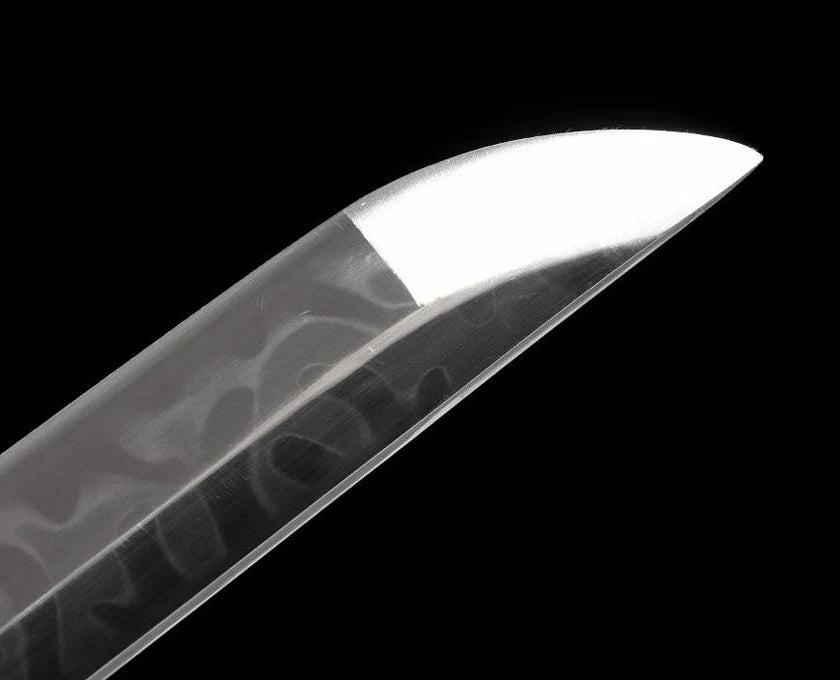
The kissaki is the tip section of the blade. It has its own shape, geometry, polish, and details. On a well-made sword, the tip should look like it belongs to the rest of the blade. It should not feel like a separate pointed piece added at the end.
The tip also gives you useful information when you are reading a modern katana listing. It cannot tell you everything about the sword, but it can show whether the maker paid attention to basic geometry and finish.
What Does Kissaki Mean?
Kissaki refers to the point section of a Japanese-style sword. On a blade with a clear yokote, the kissaki begins at the yokote and continues to the point.
The National Japanese Sword Collectors Club glossary describes the kissaki as the tip area of the blade. This area includes the point, the cutting edge, the ridge lines, and the hardened edge pattern known as the boshi.
The kissaki is easier to understand when you stop thinking of it as just the last few inches of the sword. It is a change in blade geometry.
The blade body carries most of the length. The kissaki has a different proportion and a different relationship between the edge, the spine, and the ridges on the blade. The yokote usually marks that change. Some blade shapes continue smoothly into the point and do not have a clearly defined yokote.
That difference matters when you are looking at photographs. A pointed blade does not automatically have a traditional kissaki in the same structural sense. The profile and geometry decide what you are looking at.
Why the Yokote Matters
The yokote is the line that separates the kissaki from the main body of the blade.
On a shinogi-zukuri blade, the yokote marks a change in the planes of the blade. The surface of the kissaki is shaped differently from the surface behind it. The line gives the eye a clear boundary and helps define the point.
A well-made yokote usually looks clean and deliberate. It should run across the blade with a consistent angle. It should meet the other ridge lines without looking lost, crooked, or painted on.
This is why the yokote matters on a modern sword listing. It gives you something visible to inspect.
A product page may describe a sword as having a “sharp kissaki” or a “battle-ready point.” Those phrases tell you very little. A clear photograph of the yokote tells you more. You can see whether the point has been shaped as a real section of the blade or whether the maker simply ground the end into a general triangle.
The yokote does not need to look dramatic. A subtle, clean transition is usually more convincing than a deep decorative line. On some blade styles, the yokote is absent by design. That is a shape decision, not automatically a quality problem.
Fukura, Boshi, and Ko-Shinogi
Three terms appear often when people describe the kissaki: fukura, boshi, and ko-shinogi.
Fukura
Fukura describes the curve of the cutting edge inside the kissaki.
A full or rounded fukura gives the tip a fuller shape. A straighter fukura makes the point look narrower and more pointed. You may see these described as fukura-tsuku and fukura-kareru.
The fukura changes the character of the blade. A fuller curve gives the kissaki a softer and heavier appearance. A straighter edge creates a sharper, more spear-like profile.
You can usually judge the fukura from a good side-view photograph. Look at the cutting edge as it moves from the yokote to the point. The curve should be intentional and consistent with the rest of the blade.
Boshi
The boshi is the hamon pattern in the kissaki.
On a traditionally differentially hardened blade, the hardened edge continues into the point and turns around the tip. That hardened pattern is the boshi. Its shape can be studied in the same way that collectors study the hamon along the main edge.
A boshi may be round, irregular, brush-like, or shaped in other traditional patterns. Modern sword listings usually do not provide enough detail to identify every traditional boshi pattern with confidence.
A bright line near the tip is not automatically a visible boshi. It may be a reflection, a polish line, or an artificial hamon effect. A close-up photograph helps. Clear terminology on the product page helps more.
Ko-Shinogi
The ko-shinogi is the short ridge line associated with the kissaki. It connects the geometry of the blade body to the geometry of the point.
Where the shinogi, yokote, and ko-shinogi meet, the lines create a visible junction often called the mitsukado. This junction is one of the places where the structure of the kissaki becomes easiest to read.
You do not need to memorize every term before buying a sword. These terms give you a better way to describe what you are seeing. Instead of saying that the tip “looks strange,” you can look at the yokote, the fukura, and the ridge lines separately.
The Katana Terms for Beginners guide is useful when a product page starts using these words without showing what they mean.
How to Tell Different Kissaki Shapes Apart
Kissaki types are named according to their proportions and profile. The categories describe the shape of the point. They do not provide a complete quality rating.
Ko-Kissaki
Ko-kissaki means a small kissaki.
The point is relatively short compared with the width and proportions of the blade. It gives the sword a compact, older-looking profile and usually creates a quick visual transition at the end of the blade.
A ko-kissaki works best when the rest of the blade has matching proportions. A small point on a broad, heavy modern blade can look accidental.
Chu-Kissaki
Chu-kissaki means a medium-sized kissaki.
This is the balanced shape most buyers will recognize. The point has enough length to be clearly defined without dominating the blade.
Many modern katana use a chu-kissaki because it suits a wide range of blade proportions. It is an easy shape to live with visually. The point looks purposeful, and the sword does not need an exaggerated profile to appear complete.
O-Kissaki
O-kissaki means a large or long kissaki.
The point extends farther forward and becomes a major part of the sword's appearance. It can make the blade look dramatic and powerful.
A long kissaki needs good proportion. The blade should support the length of the point through its width, curvature, and overall shape. A long tip attached to an otherwise ordinary blade can make the sword look front-heavy.
Ikubi-Kissaki
Ikubi-kissaki is a short, broad kissaki. The name is often translated as “boar neck” because of its thick, compact appearance.
The tip does not project forward as far as an o-kissaki. Its strength comes from width and mass rather than length. The result is a blunt-looking but purposeful point.
This shape is easy to recognize in a side profile. The kissaki looks wide near the yokote and short toward the tip.
Kamasu-Kissaki
Kamasu-kissaki has a narrow, pointed profile with little fukura.
The edge runs more directly toward the tip. The kissaki can look almost spear-like, especially when the point is long and the edge curve is shallow.
Kamasu is a useful term when describing appearance. It does not tell you what steel was used, how the blade was heat-treated, or how durable the sword will be.
Why Some Blade Shapes Do Not Have a Clear Yokote
A clear yokote belongs to certain blade geometries. Other shapes continue into the point without a separate transverse line.
Shinogi-zukuri blades usually have a defined shinogi, yokote, and kissaki. The blade body and point are visibly separated.
Hira-zukuri blades have a flatter construction. They often lack the same ridge structure and may not have a distinct yokote.
Shobu-zukuri blades have a shinogi that continues toward the point. The blade takes on a leaf-like profile, and the point flows out of the main body without a clear yokote.
Kissaki-moroha-zukuri blades use a double-edged section near the point. Their geometry follows a different design logic again.
This is why the absence of a yokote needs to be judged against the blade shape. A product page should identify the style clearly. The Parts of a Katana Blade guide can help you compare these basic forms.
A maker should not add a fake yokote to every blade simply because buyers expect to see one. The line belongs to the design.
What the Kissaki Can Tell You
The kissaki can tell you about the sword's proportions, geometry, and visible finish.
It can show whether the point matches the width of the blade. It can show whether the fukura has been shaped smoothly. It can show whether the yokote is crisp and whether the ridge lines meet in a believable way.
The kissaki can also help with traditional sword study. The shape of the point, the curvature of the blade, the nakago, and the overall sugata can contribute to understanding a sword's period and design background. The Kyoto National Museum discusses how the overall shape, kissaki size, curvature, and tang work together when Japanese swords are studied.
For a modern commercial katana, the kissaki gives you a more practical kind of information. It shows whether the product has been designed as a complete object.
The point should match the blade's personality. A broad blade with a tiny point, a thin blade with an oversized point, or a yokote that disappears halfway across the blade can make the sword feel poorly resolved.
The University of Kiel's sword terminology guide is useful here because it separates the terms for the point, the yokote, the boshi, and the blade ridges. Once those parts are separated, the blade becomes easier to read.
How to Read the Kissaki on a Modern Product Page
Start with the clearest side-view photograph. A dramatic angle can make the sword look impressive while hiding the geometry of the point.
Look for these details:
-
The yokote should have a clear and consistent position.
-
The fukura should curve smoothly toward the tip.
-
The point should be symmetrical in the visible profile.
-
The ridge lines should meet without obvious gaps or awkward transitions.
-
The kissaki should match the width and thickness of the rest of the blade.
-
If the listing claims a visible hamon, the pattern should continue into the boshi area.
-
The product description should use terms that match the photographs.
Pay attention to the relationship between the tip and the rest of the sword. A good kissaki does not need to be large or aggressive. It needs to look intentional.
If the listing only shows a full-length photograph, you may not be able to judge the kissaki properly. If the seller uses phrases such as “razor sharp point” without showing the yokote, fukura, or tip close-up, the important information is missing.
The same approach works across different sword styles. First identify the geometry. Then judge the finish. Use the terminology to describe what is visible.
Leave a comment
All comments are moderated before being published.
This site is protected by hCaptcha and the hCaptcha Privacy Policy and Terms of Service apply.