
1045 vs 1060 Steel for Katana: Which Is Better?
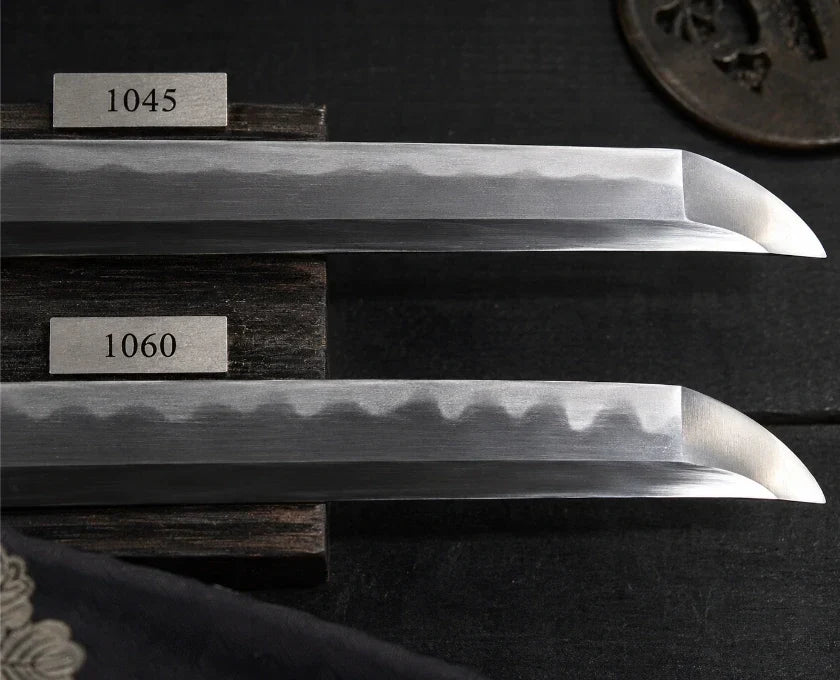
If you're comparing two equally well-made katana, 1060 is usually the better choice for a sword you intend to use. It contains more carbon than 1045, so the maker can develop a harder edge that holds its sharpness longer.
1045 is still a reasonable option, especially when price matters. It has lower hardness potential, but its lower carbon content generally favors ductility and toughness. A well-made 1045 katana can be a useful first sword.
The catch is that you're rarely comparing steel alone. Heat treatment and blade construction can easily outweigh the difference between these two grades. A properly treated 1045 blade can be a better purchase than a poorly treated 1060 one.
What are 1045 and 1060 carbon steel?
1045 and 1060 belong to the SAE 10xx family of plain carbon steels. Both consist mostly of iron, with carbon and manganese. Neither contains the large amount of chromium associated with stainless steel.
Their main difference is carbon content. According to eFunda, 1045 contains about 0.43% to 0.50% carbon, compared with about 0.55% to 0.65% for 1060. Both contain roughly 0.60% to 0.90% manganese.
For convenience, you'll often see those carbon figures rounded to:
-
1045: approximately 0.45%
-
1060: approximately 0.60%
A difference of 0.15 percentage points sounds small. In steel, it's enough to affect the hardness the maker can achieve through heat treatment.
These are closely related materials. Much of what changes between them comes from how that additional carbon affects the finished blade.
1045 vs 1060 steel: Quick comparison
| Feature | 1045 steel | 1060 steel |
|---|---|---|
| Carbon content | 0.43% to 0.50% | 0.55% to 0.65% |
| Maximum hardness potential | Lower | Higher |
| Edge-retention potential | Lower | Higher |
| Toughness and ductility | Lower carbon generally favors these properties | Can retain useful toughness with appropriate heat treatment |
| Differential hardening | Possible | Possible, with greater edge-hardness potential |
| Genuine hamon | Depends on heat treatment | Depends on heat treatment |
| Rust resistance | Low | Low |
| Care | Keep dry and lightly oiled | Keep dry and lightly oiled |
| Common reason to choose it | Lower price for a first katana | Better edge performance in a functional katana |
The performance comparisons describe general tendencies under comparable conditions. They aren't guarantees about individual swords.
For a buyer who expects to use the blade, 1060's extra edge-hardness potential is often a worthwhile reason to spend a little more.
How carbon content changes a katana
Carbon helps steel develop hardness during heat treatment. When the maker heats the blade to an appropriate temperature and cools it quickly enough, some of the steel's internal structure can transform into martensite.
ASM International describes how increasing carbon raises strength and hardness while generally reducing ductility and toughness in comparable microstructures. It also notes that the hardness of iron-carbon martensite rises with carbon content up to roughly the 0.6% range.
That helps explain why 1045 and 1060 can behave differently, even though their compositions are fairly close.
Hardness
1060 can reach a higher hardness than 1045 under comparable quenching conditions. But neither grade has one fixed Rockwell hardness.
An online chart might assign a particular HRC number to 1045 and another to 1060. Those figures only mean something if you know the condition of the steel being measured.
The finished blade's hardness depends on heating temperature, quenching conditions and tempering, as well as its geometry. A maker can use the same grade to produce blades with different properties.
So 1060 has a higher hardness ceiling. That doesn't establish which of two finished katana is harder.
Toughness and forgiveness
A long, relatively thin blade experiences more than force at its cutting edge. It can bend, vibrate and take sideways loads. Hardening it excessively can leave it less able to tolerate those forces.
Under comparable conditions, 1045's lower carbon content generally favors ductility and toughness. A maker can use those properties to produce a more forgiving blade.
That is a tendency in the material, rather than permission to assume a 1045 sword will tolerate poor handling. Heat treatment and construction still determine how the finished blade behaves. Nor should you assume that 1060 is brittle simply because it contains more carbon.
Edge retention
1060's higher hardness potential is most useful at the edge. With appropriate heat treatment, the edge can better resist deformation and wear, helping it stay sharp during use.
Geometry makes a difference here too. A poorly shaped 1060 edge may perform worse than a well-made 1045 edge, regardless of what the product description says about the steel.
When blade geometry and workmanship are comparable, 1060 generally has the advantage in edge retention.
Is 1060 steel better than 1045 for a katana?
For most functional katana, 1060 is the stronger choice between the two. It has enough carbon to develop a hard edge while allowing the maker to retain useful toughness in the blade.
That makes it a sensible step up from an affordable 1045 sword, particularly if you care about edge retention. Increasing carbon indefinitely, however, does not keep making a sword better.
You also need to consider how the blade is built:
-
Blade geometry and cross-section
-
Edge shape
-
Heat treatment
-
Tang construction
-
Fittings and assembly
-
Quality control
The steel specification tells you very little about those details. A 1060 label alone is not a reason to overlook poor workmanship.
Why heat treatment matters more than the steel number
Heat treatment determines how the steel's capabilities translate into the finished blade.
Changes in heating temperature, cooling rate and tempering can produce different combinations of hardness and toughness. Blade thickness also affects how the steel cools.
ASM International distinguishes maximum attainable hardness from hardenability, which concerns how readily steel hardens through a section. The cooling conditions affect how much martensite forms, so knowing the grade doesn't tell you the blade's final structure.
When a listing says "1060 carbon steel," you still need information about how the maker treated it.
Through-hardened katana
Through hardening aims to produce relatively consistent hardness through much of the blade.
Done properly, it can produce durable modern production swords. It does not normally create the distinct hard edge and softer body associated with a differentially hardened katana.
Differentially hardened katana
Differential hardening gives different parts of the blade different properties.
In traditional Japanese swordmaking, the smith applies clay or a similar material in varying thicknesses before the quench. The edge cools quickly, while more heavily protected areas cool more slowly.
This produces a harder edge and a relatively softer, tougher body or spine. The maker can develop edge hardness without bringing the whole blade to that same hardness.
How 1045 and 1060 compare in differential hardening
Both steels can be differentially hardened.
1060 gives the maker more hardness to work with at the edge because of its higher carbon content. That makes it a useful choice for this treatment.
1045 can also produce a functional differentially hardened blade. Its limitation is the lower hardness the edge can reach, rather than an inability to undergo the process.
Does 1060 steel make a better hamon?
A 1060 blade does not automatically have a genuine hamon.
The hamon is associated with structural changes created during differential hardening, which polishing makes visible. Its presence depends on how the blade was treated, rather than whether the steel number is 1045 or 1060.
A through-hardened 1060 blade can have no genuine differential-hardening hamon. A properly differentially hardened 1045 blade can have one.
Appearance alone can also be misleading. Some blades have etched or mechanically applied patterns that imitate a hamon, so a visible line is not proof of differential hardening.
Our guide to what a hamon is explains how a genuine hamon differs from a decorative pattern.
What traditional Japanese sword steel can teach us
1045 and 1060 are modern industrial steels. Traditional Japanese swords use materials and production methods that differ substantially from those used for these grades.
Tamahagane produced in a tatara furnace has variable carbon content, sometimes very high. The smith selects material and refines it through repeated heating, stacking and forge welding.
The reference describes roughly 0.6% to 0.7% carbon as an ideal range for refined sword steel. That is close to 1060's nominal carbon content, though the similarity only goes so far.
1060 is not tamahagane. The materials differ in their raw ingredients and smelting process, the distribution of carbon and impurities, and the way forging and consolidation affect their internal structure.
Traditional sword construction may also combine steels with different carbon contents. For example, describes higher-carbon outer steel with a lower-carbon core, using the softer core to help absorb impact.
The comparison helps explain a recurring problem in swordmaking: how to produce a hard cutting edge while keeping the blade tough enough for use. It does not make a modern 1060 sword equivalent to one made from traditional Japanese steel.
1045 vs 1060 katana for cutting
A properly made 1045 katana can be adequate for light, occasional cutting. Its lower price may suit someone buying a first functional sword and figuring out which blade characteristics they prefer.
If you expect to cut more regularly, 1060 is generally the better option. Its higher attainable edge hardness gives it an advantage in retaining sharpness.
This is where the quality of the individual sword matters. You need appropriate blade geometry and heat treatment in either steel. The grade alone cannot establish how well a katana will cut.
1045 vs 1060 katana for beginners
There is no requirement to start with 1045. You can choose either grade for a first sword, depending on what you want to do with it and how much you want to spend.
1045 is worth considering if:
-
Keeping the price down is a priority.
-
You mainly want a sword for collection or display.
-
You value a forgiving blade more than maximum edge retention.
-
You expect light, occasional use and the particular sword is made for it.
A first katana does not need an exotic steel. A well-made blade in a simple carbon steel can serve its purpose well.
1060 makes sense if:
-
You expect to use the sword regularly.
-
You care about how long the edge holds its sharpness.
-
You want useful edge hardness without moving to a much higher-carbon grade.
-
The price difference fits your budget.
If those points describe what you're looking for, there's little reason to buy 1045 simply because you're a beginner.
Does 1060 rust more easily than 1045?
For ordinary katana ownership, neither steel has a meaningful corrosion-resistance advantage. Both can rust.
Fingerprints and sweat leave moisture and residue on the blade. Humid storage can cause problems too, especially if the steel has no protective oil.
Whichever grade you choose:
-
Wipe away fingerprints and moisture after handling.
-
Keep the blade dry.
-
Apply a very thin layer of suitable protective oil.
-
Avoid damp storage conditions.
These habits matter much more than the small difference in carbon content. Our guide on how to clean and oil a katana explains the process in more detail.
1045 vs 1060 vs 1095: Where do they fit?
Adding 1095 makes the general progression easier to see.
| Steel | General tendency with appropriate heat treatment |
|---|---|
| 1045 | Lower hardness potential, with more emphasis on ductility and toughness |
| 1060 | A practical balance of edge hardness and toughness |
| 1095 | Greater hardness potential, with less margin for toughness |
This is a guide to material tendencies, rather than a ranking of finished swords.
1095 does not automatically make the best katana because it contains the most carbon. The maker has to choose properties that suit the blade and use heat treatment appropriate to the steel.
Our comparison of 1045 vs 1060 vs 1095 steel for katana covers the differences in more detail.
Which steel should you choose?
Choose 1045 when affordability is your main concern and the particular sword is well made for your intended use. Its lower carbon content is a limitation on attainable hardness, not a reason to dismiss the blade.
Choose 1060 when you want a functional katana with better edge-retention potential and the price difference is reasonable.
If both swords have comparable design, construction and heat-treatment quality, 1060 is generally the better purchase. If those details differ, give them more weight than the steel number. A well-made 1045 katana is preferable to a 1060 sword whose heat treatment or assembly is poor.
FAQ
Is 1060 steel good for a katana?
Yes. With approximately 0.60% carbon, 1060 can develop a hard edge while retaining useful toughness through appropriate heat treatment. It is a practical plain carbon steel for a functional katana.
Is 1045 carbon steel good for a katana?
Yes, particularly for an affordable first sword. Proper heat treatment can produce a durable blade. Compared with 1060, its main limitation is lower edge-hardness and edge-retention potential.
Is 1060 stronger than 1045?
It depends on what you mean by "stronger." 1060 has greater hardness and strength potential, while 1045 generally retains more ductility and toughness under comparable conditions, as described in the ASM International material discussion.
For a katana, no single measurement tells you how good the blade is. Its geometry and heat treatment need to produce properties suited to its intended use.
Which is better, 1045 or 1060 steel?
1060 is usually better for a functional katana when the two swords are otherwise comparable. 1045 remains a reasonable lower-cost option. A difference in workmanship or heat treatment can matter more than the difference in carbon content.
Can 1045 steel have a real hamon?
Yes. A properly differentially hardened 1045 blade can have a genuine hamon. The steel does not have to be 1060.
Is 1060 better than 1095 for a katana?
Neither is universally better. 1095 has more carbon and greater hardness potential. 1060 can provide a more moderate balance of edge hardness and toughness, which suits many functional katana. The better choice depends on the blade's design and heat treatment.
Read more
The katana is the sword most people recognize first. Its long curved blade, wrapped handle, and lacquered scabbard have become the familiar image of the samurai sword. The wakizashi is shorter, but...
Run your eye along the side of a katana blade and you may notice a long groove near its back. That is often a bo-hi. It is cut into the steel, usually on the flat area between the blade's ridge (sh...
Leave a comment
All comments are moderated before being published.
This site is protected by hCaptcha and the hCaptcha Privacy Policy and Terms of Service apply.