
How to Prevent Rust on a Katana
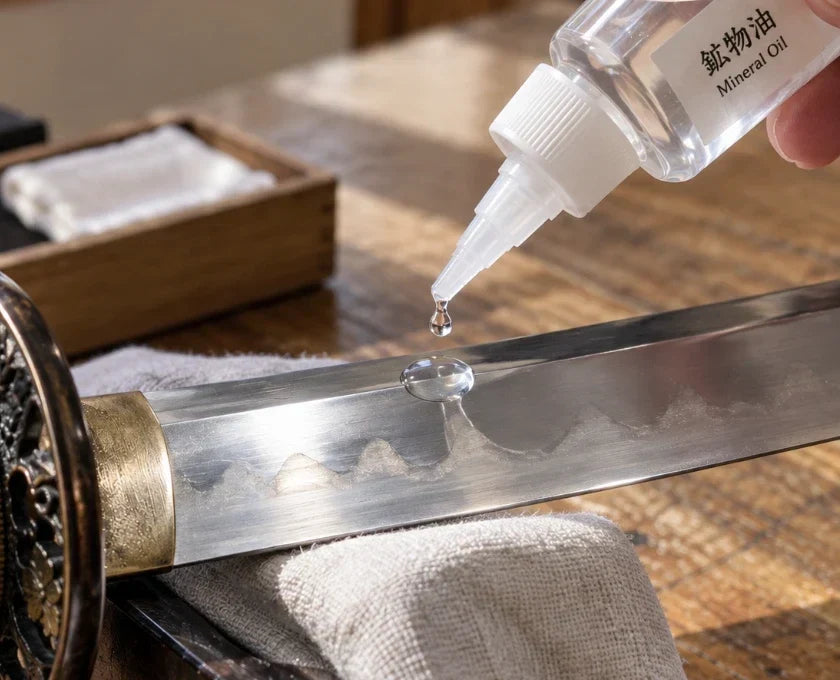
A practical guide to cleaning, oiling, and storing a modern carbon-steel sword
You put the katana away after handling it for a few minutes. The blade looked clean. A week later, you draw it and find a small brown mark exactly where your fingers touched the steel.
It is an easy mistake to make. Fingerprints leave moisture and salts behind, and carbon steel gives them time to work if the blade is left uncleaned. Preventing rust rarely calls for elaborate equipment. It calls for noticing what touched the blade, cleaning it off, and keeping moisture away while the sword is stored.
This guide is for modern production katana, especially carbon-steel blades. If you have an antique, a traditionally made Japanese sword, or a potentially valuable blade, leave rust removal and restoration to a qualified specialist.
Why rust starts with an ordinary fingerprint
Steel rusts when moisture and oxygen reach its surface. Humid air can provide the moisture; handling can add sweat, salts, and skin oils. A blade does not need to be left out in the rain to develop a spot.
That is why a quick inspection after handling matters more than a complicated cleaning ritual once a month. Look along both sides of the blade under good light, particularly where fingers may have touched it. If it has been used for cutting, check for residue as well. What looks harmless while it is fresh becomes less charming after a few days in the saya.
Clean first, then oil
Oil helps protect a clean blade. It does not make fingerprints, water, or cutting residue disappear. Putting fresh oil over them simply gives the problem a protective coat of its own.
Use a clean, soft, lint-free cloth to remove fingerprints and residue. Work slowly, keep your hands clear of the edge, and avoid pressing toward it. If the sword has been exposed to rain, condensation, or a damp room, make sure the blade is completely dry before oiling and sheathing it.
Skip sandpaper, steel wool, household abrasives, and aggressive metal polish during routine care. They may remove more than the mark you meant to clean, especially on a finished or polished blade.
The oil should be barely noticeable
Choji oil is a traditional choice for Japanese sword care. For many modern production swords, a suitable mineral oil or the oil recommended by the maker is also practical. Follow any care instructions supplied with your sword, since finishes and materials vary.
Put a small amount of oil on a clean cloth or applicator, then spread a thin, even film over both sides of the blade. The surface should look lightly protected, not wet. If you can see oil gathering or running, wipe off the excess.
More oil sounds like more protection, but the saya would like a word. Excess can transfer inside it, collect dust, and leave residue where the blade meets the scabbard. The useful amount is the thin layer that stays on the steel.
The saya can hold on to a problem
Sheathing a damp blade does not make it dry; it puts the moisture somewhere harder to see. After handling or cutting, clean and inspect the blade before returning it to the saya.
If rust repeatedly appears in the same place, particularly where the blade contacts the inside of the saya, consider whether the scabbard has retained moisture or debris. Do not force a cloth, abrasive, or chemical cleaner inside to investigate. If the blade is valuable or traditionally made, ask a qualified sword specialist to assess it.
For storage, choose a clean, dry indoor place with reasonably stable temperature and humidity. Avoid damp basements, garages, and other spaces where the conditions change sharply. Salt air and humid seasons call for more frequent checks, even when the sword has not been used.
How often should you check it?
There is no calendar that suits every sword and every room. A display sword in a dry, stable home has different needs from one used regularly for cutting in a humid climate.
Inspect the blade after bare-hand contact, cutting practice, travel, exposure to moisture, or a long period in storage. Check sooner if the oil looks dirty or sticky, or if the steel changes appearance. Clean off old, contaminated oil before applying a fresh, thin layer. Adding new oil on top is maintenance only in the most optimistic sense of the word.
If you find rust
Pause before trying to remove it. Sandpaper, steel wool, a polishing wheel, or a strong cleaner may change the blade's finish and make the damage harder to repair properly.
For a modern production katana, contact the maker or seller for advice suited to its steel and finish. For an antique, traditionally made, signed, or potentially valuable Japanese sword, stop using it and consult a qualified Japanese-sword polisher or specialist. Preventing rust is routine care; removing it without harming a blade is a separate job.
The everyday routine is short: clean off what touched the blade, let it dry completely, apply a thin layer of suitable oil, and store it somewhere dry. The blade does not need constant attention. It needs attention at the right moments.
Read more

If I had to give a short answer, I would say this: 1060 and 1095 are not simply good steel and bad steel. They are two different ways of balancing hardness, toughness, and edge retention. For a fir...
A decorative katana is not a bad katana. In fact, it may be exactly the right choice if you want a display piece, a collectible, a gift, or a replica that looks good on a stand. Problems start when...
Leave a comment
All comments are moderated before being published.
This site is protected by hCaptcha and the hCaptcha Privacy Policy and Terms of Service apply.